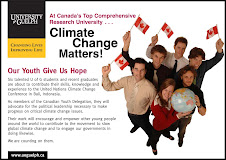
While international negotiators are finalizing their position statements, and pressing their shirts for the start of the conference, the International Youth delegates were already hard at work.
Today, almost 200 youth from over 50 countries joined together to develop our shared vision, strategy, and positions as we head into the 14th UN climate change conferences. Beginning with some inspiring messages about why we have been brought together in Poland, participants learned the history of youth involvement, the basics of the policies involved, and the opportunities for making a difference here in Poland, as well as next year in Copenhagen.
After lunch, the youth split into various working groups, including communications, media, actions, and policy. Being of the policy bent myself, as any readers can probably now guess, I joined in with this working group. I was in disbelief over how much the interest in policy has grown since last year! We went from a group of about 10 international youth, to over 50 since last year. We were able to develop subgroups on 6 key issues, which include Forestry issues, Clean Development Mechanism issues, Mitigation, Adaptation, Finance, and Technology Transfer.
I'm very excited at how well the group is working together, and how well-organized we will be this year. Our objectives will be to follow these 6 areas, translate the policy developments into plain language for the media, communications, actions, and other groups, and develop a unified youth voice on our position on these issues.
I have been wonderfully amazed at how well such a large group of young people from such diverse backgrounds and cultures seem to cooperate seamlessly. We are able to agree on issues effortlessly, and share a strong, unified vision of reversing the climate change trends. A look around the large room at all these passionate, dedicated faces suggests that these are my teammates, and my partners in this quest to slow or end the destruction to our climate. Mal, a UK youth delegate, said it best when he said, "we are setting an example for how the international community should be cooperating on this issue". I couldn't agree more.
Saturday, November 29, 2008

Wednesday, November 26, 2008
...And they're off!

This is it, everyone! Tonight, I take a bus to Toronto to meet most of the delegation for the first time, do an interview with The Weather Network, and finalize the Canadian Youth Delegation's positions on the top five major issues to be discussed in Poznan.
I cannot wait to finally interact face-to-face with the incredible, motivated, and inspiring young people I have been on the phone with weekly for the past 4 months. Tonight will be a celebration, a launch, a deep breath, and a sigh.
Getting any work done today at the real job is going to be tough!
Next time I write, it will be from Poland!!
(NB: regarding the picture, replace the word "Bacon" with "CYD" and that's pretty much an accurate picture of my feelings at the moment...although, admittedly, I sometimes get that excited about Bacon)
Monday, November 24, 2008
CCS in Canada not all its cracked up to be
In an email sent out from one of our policy team members today, we learned from the CBC the following:
To summarize: according to Secret Ministerial Briefing Notes prepared by the
Canada-Alberta Task Force on Carbon Capture and Storage (obtained through a FOIP request by the CBC), Carbon Capture and Storage is a technology ill-suited to
most oilsands projects. You read that right, the technology being touted abroad
by countless Canadian and Albertan politicians as a pancea for mitigating
oilsands GHG emissions will not actual result in significant reductions, because
most oilsands operations do not meet the criteria for an effective CCS
operation. Please see the link below:http://www.cbc.ca/canada/story/2008/11/24/sands-trap.html
Saturday, November 22, 2008
Taking the fizz out of Carbon Capture and Storage

This week’s final fabulous policy presentation was on the topic of questionable technologies such as carbon capture and storage and nuclear energy, and their role in the Clean Development Mechanism.
Carbon Capture and Storage (CCS) is a technique that removes CO2 from large point sources of emissions, and either pipes it underground or underwater to prevent it from entering the atmosphere. It does not remove existing CO2 in the atmosphere (although a fairly new discovery suggests that basaltic rock has co2 absorbing properties). CCS is capable of capturing 85-95% of CO2 in some cases. The CO2 is often transported along pipelines and either stored underground using well-established geologic technology, or piped to the bottom of a large and deep lake or ocean where the pressure keeps the gas from escaping. A new technique called mineralization is currently being researched, but is at the moment far more energy intensive than the geologic or oceanic sequestration techniques mentioned previously.
The oil and gas industries have been using CCS to help bring these fuels to the surface for easy extraction; however, the storage capacities of geologic sequestration are not well understood. This mechanism is also at risk from seismic activity, crack or fissure developments, or ruptures into undetected wells. There are significant biological problems with the ocean sequestration techniques, as any high school chemistry teacher will tell you. This is because CO2 has an acidifying property, and acid can dissolve calcium. Acidifying water guarantees significant species loss (think corals, shellfish) in our oceans – as if that isn’t already a huge problem!
The challenges surrounding the inclusion of CCS in the CDM process include such uncertainties as: how to deal with underground reservoirs that cross political boundaries, how to measure or quantify seepage, and how to select suitable sites. CCS is also an extremely pricey mitigation tool at the moment, and financing would be a significant challenge. (Keep in mind the astronomical estimated cost of adaptation to climate change, in addition to any technology and mitigation funds that may arise).
Quite honestly, I think CCS as a technology has great potential for minimizing emissions from these sectors as an interim measure while we figure out how to bust out of this oil-driven economy. Nonetheless, numerous uncertainties make it completely unsuitable for the Clean Development Mechanism. Countries such as
Saturday, November 15, 2008
Turning the Corner, or running away from responsibility?

As promised, the following is a summary of Thursday's presentation on Canadian climate change policy. It starts with the Turning the Corner Plan. PM Harper promised a "Made In Canada" approach, and came out with the Turning the Corner Plan in 2007 when John Baird was appointed Minister of Environment. The plan is actually only a proposal with no regulatory legal spine. It outlines a target of reducing Canada's greenhouse gas emissions by 20% below 2006 levels by 2020 - which amounts to a 3% increase above 1990 levels. [When we ratified Kyoto, our voluntary committment was for 6% below 1990 levels - a difference of 9%!)] The Intergovernmental Panel on Climate Change (IPCC) insists that 1990 must remain the baseline year if we are to reduce emissions enough to stay below a 2 degree C rise in global average temperature. This target is almost impossible now - we have already gone too far. Experts are saying we are already committed to a 2.4 degree C increase in temperature, meaning loss of biodiversity, significant changes in weather patterns, and increased sea-level rise.
Turning the Corner also outlines intensity targets, which means for every increase in production of a given emission, there is lower greenhouse gas emissions. This means emissions will continue to increase, at a decreasing rate. There will be a net gain. The plan was updated in March, but no details have been released yet.
The Plan treats the Oil Sands with special consideration. New industries in the Oil Sands are given a grace period to 2011 when they will be required to use Carbon Capture and Storage (CCS) technology (as yet under development, and unproven) to stash away some of their emissions. Existing industries will have until 2018, leaving only 2 years for Canada's largest source of emissions to contribute to Canada's reduction targets.
The Plan also includes a carbon offset program, where industry can pay as little as $15 /tonne of CO2 for up to 70% of their emissions. An additional 10% of emission credits can be bought from the Clean Development Mechanism. The Plan outlines a gradual increase on the price of carbon until it reaches $65/tonne in 2012; but any mistake or errors in the price increases (political or otherwise) will mean it will be cheaper for industry to simply buy off their emissions rather than reduce them.
Obama's election to the Presidency in the United States will have considerable impact on Canada's climate change policy. Due to the free trade agreements for goods between Canada and the US, our two countries will have to maintain policies that are very closely coupled; carbon taxes or other measures could potentially raise the costs of materials and goods being traded, rendering them less attractive for import. However, Obama is citing much more ambitious targets of 80% below 1990 emissions levels by 2050, using cap and trade and 'polluter-pays' policies, and investing in renewable energy. These will be very difficult targets to meet, and may be adjusted over the coming years, but it puts the pressure on Canada to smarten up a bit.
Obama also is fortunate to have strong pressure from many progressive states to adopt stricter policies on climate change. Some Canadian provinces are also trying their best. British Columbia is the first to come to mind with their recently-implemented carbon tax, and an ambitious emission reduction plan. Ontario had set reasonable targets of 6% below 1990 by 2015, 15% by 2020, and 80% by 2050, but there are no strong policies or strategies to acheive these targets. Quebec has managed to curtail emissions growth since 1990, and has actually reduced emissions by 5.5% below 2006 levels. And then there's Alberta. But I'll save Alberta for it's own posting later in the week.
The bottom line is that the federal goverment has set itself up for failure intentionally, by creating weak targets and regulatory frameworks riddled with cop-outs for the industries. If we are to have any hope of reaching the internationally-agreed targets of 25-40% below 1990 levels, then Canada will have to act immediately and with robust regulations and policies in place. I try to remain optimistic that there is still a chance of this happening, but with ever passing conference I attend, and with each consecutive "fossil of the day" award that Canada wins for being obstructionist or delaying progress, my hope dwindles. Success will require enormous public pressure, an about-face of the energy industry and major businesses, and a new perspective within the federal government.
editor's note: The book cover illustrated above is an excellent book for summarizing Canada's climate change policy, the history behind it, and how it may be possible to still reach our targets (or impossible?) . Recommended reading!!
Friday, November 14, 2008
Coming soon...

Yesterday's Policy Team enjoyed an excellent presentation from two of our members on Canadian climate change policy, and the various factors that shape what is today one of the world's weakest government attempts at greenhouse gas emissions reductions. How do the Provinces fit in? Who in Canada is leading the charge? What does Environment Minister Jim Prentice's appointment mean for Canada's climate policy? How will Canada's policy change to reflect the stronger policies proposed by the new President-elect in the United States? Stay tuned, and I'll summarize yesterday's call for you.
Saturday, November 8, 2008
Why does any of this matter?
My words alone cannot begin to convey the depths of emotion and passion and desperation behind my motivation for doing everything I can to mitigate climate change. So instead, please watch this short video. This say it all.
Start with this one:
UNDP Youth Climate Change Project Key Message Seven: Climate Change - The United Nation is well placed to lead on action. from Peace Child on Vimeo.
Imagine what it is like to be in this room at this moment:
 Imagine staring out over a sea of suits and ties adorned by emotionless faces who seem to have lost perspective. Do they care nothing for the millions of impoverished and marginalized people of this world who are being forced from their homes and cultural roots into slums and camps? Are they mere androids driven by politics and economy, who can't see beyond the next fiscal quarter, or election term? They continue to forget that their decisions will impact millions upon millions - including their own children.
Now imagine being a young person in the room during this speech. You are surrounded by your contemporaries for support - people you have become close friends within a matter of two short weeks, bound together by this common cause, this plea for a brighter future. Tears are streaming down our faces. We hold hands, hug one another, stand and watch while one of our own sends our plea to take action and stop deliberating. The world is melting away from under us. We are running out of time.
Imagine how this feels. Wouldn't you want to do anything within your power to change it?
Start with this one:
UNDP Youth Climate Change Project Key Message Seven: Climate Change - The United Nation is well placed to lead on action. from Peace Child on Vimeo.
Imagine what it is like to be in this room at this moment:
 Imagine staring out over a sea of suits and ties adorned by emotionless faces who seem to have lost perspective. Do they care nothing for the millions of impoverished and marginalized people of this world who are being forced from their homes and cultural roots into slums and camps? Are they mere androids driven by politics and economy, who can't see beyond the next fiscal quarter, or election term? They continue to forget that their decisions will impact millions upon millions - including their own children.
Now imagine being a young person in the room during this speech. You are surrounded by your contemporaries for support - people you have become close friends within a matter of two short weeks, bound together by this common cause, this plea for a brighter future. Tears are streaming down our faces. We hold hands, hug one another, stand and watch while one of our own sends our plea to take action and stop deliberating. The world is melting away from under us. We are running out of time.
Imagine how this feels. Wouldn't you want to do anything within your power to change it?
Saturday, November 1, 2008
New Website is Live
Exciting news! The Canadian Youth Delegation's new website is up and running! There are still a few kinks and bugs to work out, so please be patient with us. In the meantime, check it out and visit some of the delegate profiles to see for yourself what an incredible team we have!
www.cydpoznan.org
www.cydpoznan.org
Subscribe to:
Posts (Atom)